How are you at predicting things? If you’re like most of us, you might be OK at predicting certain things but fail miserably at others. For example, you might do better than average at predicting the score of the football match, but you can’t judge which horse will win the race. On the other hand, if you’re one of those rare folks with a natural affinity, you might be a superforecaster.
In 2011, IARPA – the US intelligence community’s equivalent to DARPA – launched a massive competition to identify cutting-edge methods to forecast geopolitical events. Four years, 500 questions, and over a million forecasts later, the Good Judgment Project (GJP) – led by Philip Tetlock and Barbara Mellers at the University of Pennsylvania – emerged as the undisputed victor in the tournament. GJP’s forecasts were so accurate that they even outperformed intelligence analysts with access to classified data.
By identifying superforecasters and then crowd sourcing what these remarkable people anticipate it’s possible to make incredibly accurate predictions about the future. Test your own abilities at the link above.
We like to think of gravity being constant. No matter where we are on the earth, we weigh the same. Except that’s not actually true. As it turns out, Gravity is not uniform. It varies geographically.
The Bouguer (pronounced boo-gay) gravity anomaly is named after French scientist Pierre Bouguer (1698-1758), a prodigy who succeeded his father as professor of hydrography at the tender age of 16. Among his many discoveries was the fact that small regional variations in the earth’s gravity field could be related to the varying density of subterraneous rocks in the subsurface.
In addition to gravitational variations caused by subsurface rocks, there are also gravitational changes that are caused by what latitude you’re on, the rotation of the earth, what altitude you’re on, and even that tidal pull of the sun and moon.
If you want to look at the gravitational measurements of your area, visit the International Gravimetric Bureau. You can look up anomalies near you and visit the specific region that has gravitational anomalies and experience it yourself.
You might be familiar with cartomancy already. It is the practice of divining the future using cards. It’s most popular today using tarot cards, which are now associated with cartomancy. But did you know that originally tarot cards were used for games while the playing cards we know today were used for divination? Each playing card has its own meaning. Here’s a list of the basic interpretations.
Hearts
Ace of Hearts: New relationships, friendship 2 of Hearts: Good fortune in love and relationships 3 of Hearts: Be cautious in your relationships 4 of Hearts: Change or travel is on the horizon 5 of Hearts: Someone in your life is jealous 6 of Hearts: Surprise new love interest 7 of Hearts: Improved connections with friends 8 of Hearts: Visitors and invitations 9 of Hearts: The “wish” card—which may come true 10 of Hearts: Good fortune is coming Jack of Hearts: Can represent a good friend or a young, blond person Queen of Hearts: A kind blond woman King of Hearts: A helpful blond man, good advice
Spades
Ace of Spades: Endings, misfortune 2 of Spades: Tough decisions, deceit, change 3 of Spades: Trouble in relationships, infidelity 4 of Spades: Illness, broken promises 5 of Spades: Obstacles and difficulty, eventual success 6 of Spades: Improvement, small wins, upswing 7 of Spades: Bad advice, grief, loss 8 of Spades: Deceit, danger, caution is advised 9 of Spades: Bad luck, depression, anxiety 10 of Spades: Bad news, worry, imprisonment Jack of Spades: An unpleasant or immature young person with black hair Queen of Spades: A dark-haired woman or widow King of Spades: A dark-haired selfish but ambitious older man
Clubs
Ace of Clubs: financial fortune, wealth, good news 2 of Clubs: Challenges, gossip 3 of Clubs: A wealthy partner and successful marriage 4 of Clubs: Deceit or betrayal, potentially by a friend 5 of Clubs: New friends and support 6 of Clubs: Success and prosperity, financial help 7 of Clubs: Success in business with potential trouble from a romantic partner 8 of Clubs: Difficulty in business and in love 9 of Clubs: New admirer or opportunities, warning against stubbornness 10 of Clubs: Unexpected money, travel Jack of Clubs: A reliable and trusted dark-haired friend Queen of Clubs: A dark-haired, helpful, and confident woman King of Clubs: A dark-haired, strong older man
Diamonds
Ace of Diamonds: A gift of jewelry, a letter or message, improvement 2 of Diamonds: Disapproval of a relationship or affair 3 of Diamonds: Legal trouble, domestic arguments 4 of Diamonds: Unexpected money, inheritance 5 of Diamonds: Improvements and success in business, happy home life 6 of Diamonds: Relationship troubles, problems in a second marriage 7 of Diamonds: Challenges at work 8 of Diamonds: Surprise romance or travel later in life 9 of Diamonds: New business opportunities, unexpected money 10 of Diamonds: Financial property, good fortune Jack of Diamonds: An unreliable or dishonest young person with light hair Queen of Diamonds: An outgoing, flirtatious woman with light hair King of Diamonds: An accomplished older man of influence with light hair
The Layout
There are many popular ways to layout the cards for a reading, but the best one is the Quad Cut Fortune Telling Procedure. Some sources even claim that it is the most accurate of any type of fortune telling or divination. This procedure has been around longer than almost every other layout and has had more research into its interpretations than any other layout. It’s a very simple procedure where the deck is shuffled and cut four times by the participant and the top card of each pile is turned over. The revealed cards and their order the readings regularly receives a 98% accuracy rating.
With four cuts from a ruffled deck, there are 6,497,400 possible outcomes (52 possibilities x 51 possibilities x 50 possibilities x 49 possibilities). It took over 3 centuries to research and categorize each possibility by 1000s of readers across the globe. To to the myriad outcomes, readers must consult the results in the 12 volume set, On the Four Card Divination Technique, which lists the meaning for every possible layout. This series of books is now online as well at otfcdt.com/layouts.
Applied Cartomancy
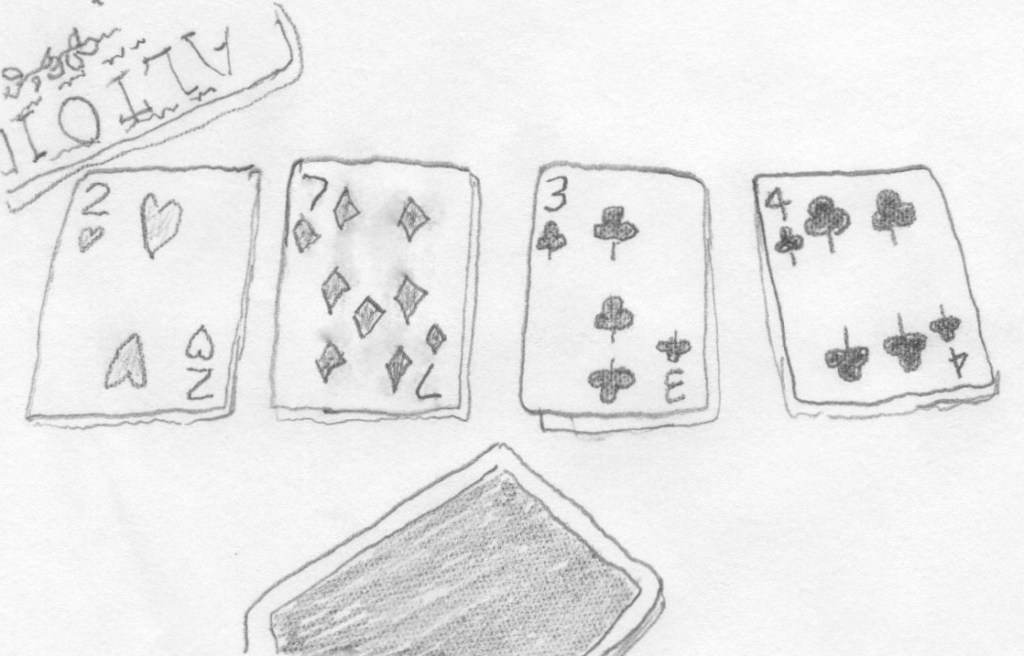
With such a huge number of possibilities you’ll need to consult the above mentioned books or web site to do an accurate reading. Below are two examples that represent the best and worst possible potential fortunes. The first listed is The Transcendent Ideal Layout, which indicates a life of sustained good fortune and happiness, regardless of the sitter’s experiences prior to the reading. The second is known as The Painful Life/Impending Death Layout. That combination indicates a short life to come, filled with the darkest of miseries. It should be noted that neither layout has ever been documented in a recorded session, but anecdotes suggest they have appeared a few times since the 1500s.
The Transcendent Ideal Layout from “On Four Card Divination Technique”The Painful Life/Impending Death Layout from “On Four Card Divination Technique”
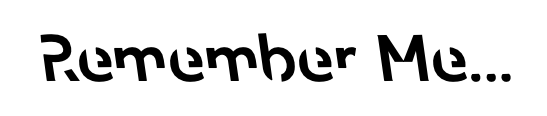
Do you want to be able to read something and better remember it with less effort? You might want to try a new font, Sans Forgetica.
Sans Forgetica is a font designed using the principles of cognitive psychology to help you to better remember your study notes.
It was created by a multidisciplinary team of designers and behavioural scientists from RMIT University.
Memory is a fascinating thing. While reading something in this font can help you recall what you’re reading later, when combined with other techniques the results can seem quite amazing. For example, a memory technique known as “gradual immersion” is quickly being regarded as the best method for learning things like a second language. It was once thought that the best way to learn a language would be to fully immerse yourself in the language, but that’s now known to induce too many stressors. It’s much better to gradually immerse yourself in the material you’re trying to memorize.
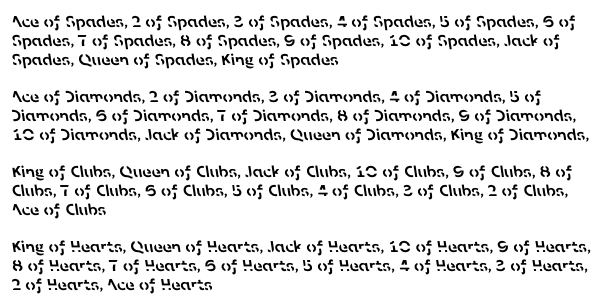
Here’s an experiment to try combining the gradual immersion technique along with Sans Forgetica. Read this list of cards out loud to yourself.
Now take any shuffled deck of cards and deal them face up one at a time. Don’t try to memorize the order, just watch the cards go by and name each card out loud. Repeat, but this time do every other card or even larger blocks of cards at once. Repeat once or twice more looking at fewer cards in the stack. The above font, combined with the gradual immersion technique should allow you to memorize a shuffled deck of cards in a remarkably short amount of time – with almost no effort.
We know that time flies when you’re having fun. New psychology research now confirms that when you lie your perception of time slows down. Subjects who were instructed to lie underestimated the amount of time that passed while lying.
“You may have had an experience where you got nervous and wanted to escape from the situation when you attempted to deceive the other players in a card game, for example. In such a case, you might have felt that time passed slowly,” said study authors Izumi Matsuda and Hiroshi Nittono, an associate professor at Aoyama Gakuin University and a professor at Osaka University, respectively.
Two interesting points emerge after examining this research. First, it’s possible for people to train themselves to be better liars. Secondly, it may be possible to use this phenomenon as a means to deliberately distort an individual’s sense of time. Imagine being able to simulate “lost time” through a procedure of intentional lying and truth telling. The article notes that the effects outside of the lab may actually be stronger in real-world settings.
“It’s really important to understand we’re not seeing reality,” says neuroscientist Patrick Cavanagh, a research professor at Dartmouth College and a senior fellow at Glendon College in Canada. “We’re seeing a story that’s being created for us.”
Our perception of reality is created in our brains and isn’t a true representation of the real world. Using functional magnetic resonance imaging scientists explored how our brains interpret optical illusions and compared brain activity to the subjects viewing a true recreation of the same illusion. Their hypothesis is that a comparison of the brain activities should indicate whether the illusion happens in the visual context or in some other part of the brain. And what they found seems to indicate that the visual processing in the brain isn’t fooled by the illusion, it happens in another part of the brain.
Dr. Mike Rubenstein of the New York Center for Magnetic Studies said, “This fMRI research being done at the NYCMS is expected to not only expand our understanding of how our brains interpret optical illusions but also how to induce similar illusions in other circumstances.”
Early one morning, Tandy arrived at the lab and found a terrified cleaning woman running from the premises. She was unable to explain what exactly had happened, apart from an overwhelming sense of dread and the feeling that she was distinctly not alone. Tandy chalked it up to her having worked the night shift isolated in a creaky old building. But in the following days, Tandy and his two equally hard-nosed and skeptical lab mates noticed an odd, unsettled atmosphere associated with their workspace. Tandy described it as a “depressed” feeling, and complained of breaking out into cold sweats. And there were other odd occurrences—in one instance, a fellow was working at a workbench and felt someone watching over his shoulder, but when he turned to address them there was no one present. On another occasion, while Tandy was working alone, he became convinced that a gray, indistinct apparition was waxing at the edges of his vision, but he swiveled his head only to find that the thing, whatever it had been, had vanished.
Erin Anderson
Tandy, a skeptical engineer, methodically investigated these and other strange occurrences at the haunted lab. He didn’t find any real ghosts, but in the process he discovered how you can manufacture ghostly experiences through sound.
Tandy found that a new exhaust fan had recently been installed. Its installation coincided exactly with the terror-stricken cleaning woman. Apparently the combination of the fan and the geometry of the room had produced a standing sound wave at a frequency of just under 19 Hz. This frequency, part of a region of frequencies dubbed infrasound, is just out of the range of normal human hearing, but is very close to the average resonant frequency of a human eyeball. This caused the lab workers’ eyes to vibrate very slightly, prompting the curious optical illusions.
Erin Anderson
You won’t be able to hear the sine wave in this embedded video, it’s below the range of our hearing. Try putting it on in the background and see if it induces ghostly experiences for you.
In the 1930s German psychologist Wolfgang Metzger pioneered a method of perceptual deprivation found to induce hallucinations, later referred to as the “Ganzfeld effect,” from the German for “complete field.” In the 1970s and 80s two American parapsychologists, William Braud and Charles Honorton, began using the same approach to test psychokinetic influences on living systems.
The point of their experiments was based on the assumption that ESP is such a weak force, that our everyday senses tend to drown them out. Test subjects had their eyes covered, were bathed in red light, and wore headphones with white noise drowning out all other sounds. Honorton’s meta-analysis of several studies found a 35% hit rate, a 10% increase over random chance, if true. More recent studies have come up with a hit rate of 32.2%.
It is possible to recreate the effects on your own, albeit in a biased, non-scientific trial. Your sense of sight and sound are the two most prominent sense that are said to drown out psi abilities. A simple blindfold and earphones playing white noise are easy to procure. The sense of smell, oddly enough, may actually be more important. Different studies have tried a variety of approaches to inhibit or deprive the olfactory sense. Some have tried overwhelming the subject’s sense of smell through strong odors, while others inhibit the subject’s ability to breathe through the nose at all.
I see all sorts of interesting uses for this. Imagine creating glass that has the perfect refractive index for room temperature air. Depending on the quality of the glass you would probably have to turn the heat up (or down).
You might be familiar with number stations already. These are short-wave radio broadcasts used for espionage. Spies for various countries have been using these since World War I as ways of receiving coded information. They’re called “number” stations because they use codes that use numbers. They broadcast these strange messages in a loop.
You might not be as familiar with card stations. Similar to number stations, card stations were first noticed in the 1960s and 1970s and mainly originated in rural America. Instead of reciting a string of seemingly random numbers these broadcasts sounded like they were instructions for a card game. “Discard the Ace of Spades and keep the Queen of Hearts.”
At first it was assumed that card stations were like number stations, a way to transmit clandestine information to spies. However, there are some strange things that happen when listening to the card stations combined with Black Noise. The U.S. government’s official statements are that these are some elaborate hoax, but I’m not so certain. Are they the result of some mad scientist’s mind control experiments? Space aliens?




 Quirks and Curiosities