Phrenology

Phrenology was developed in 1796 by a German physician, Franz Joseph Gall (1758-1828). Based on the idea that measuring the contours of the human skull predicts personality traits, it was an early influence in the fields of psychology and neurology. Gall’s methodological standards were quite poor, even for his day, and many of his contemporaries had already regarded phrenology as a pseudoscience even in the 19th century.
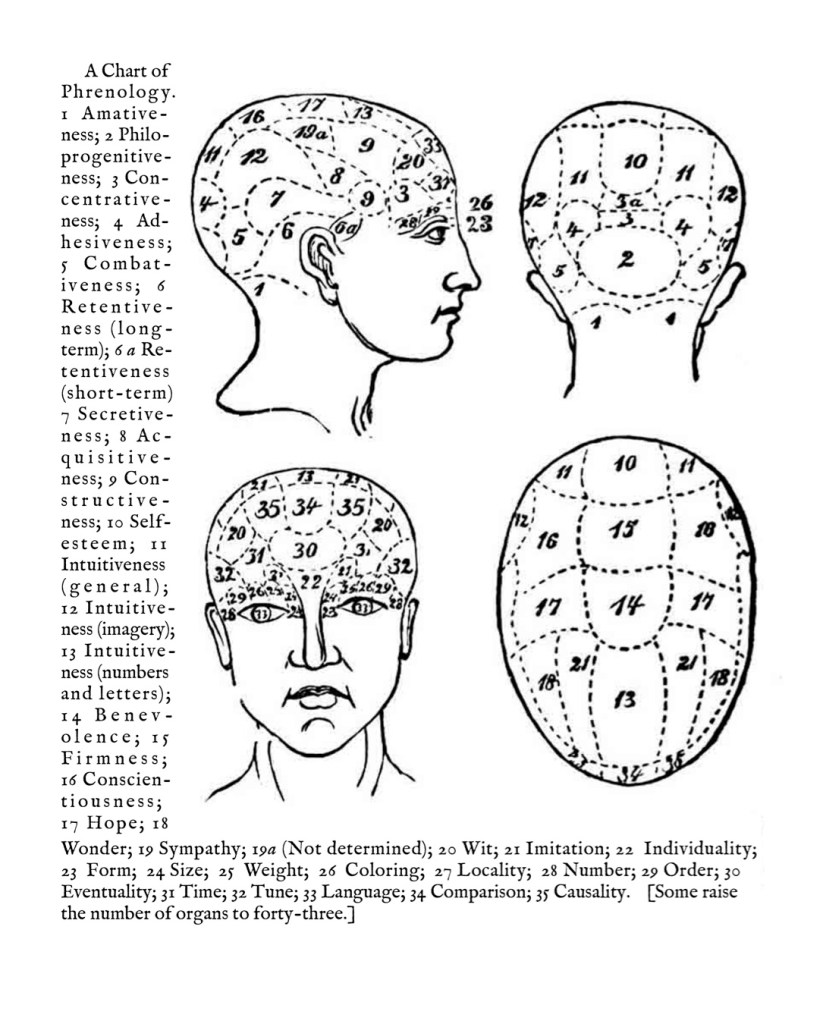
While idea that the bumps on your head accurately predict your personality has been debunked, modern neurology does show that there are localized brain functions and they can be influenced. In fact, using techniques such as transcranial magnetic stimulation and even something as simple as gentle massage (for at least 60 seconds) can actually trigger a noticeable effect. For example, if a magnet is applied to area 14 in the chart above (benevolence) you might notice that individual is more charitable. Massage area 13 (intuitiveness for numbers and letters) for a couple of minutes the next time you’re stuck on a crossword or sudoku puzzle.


Binaural Beats: Quirky Aural Illusion or Brain Hack?

You’ll need to be wearing headphones for this to work. Go ahead and grab some, I’ll wait.

Now that you have headphones on, listen to this audio file.

What you’re hearing is an example of binaural beats. There is a tone played in each ear that are just slightly out of tune with each other. This produces the pulsing you’re hearing and the illusion of a third tone. Take one headphone off and you’ll hear just a single sine wave tone.

There are some who claim that listening to binaural beats are a way to “hack” your brain. The evidence for this is spotty, at best, however there is some indication that it might actually have a positive effect on memory. You can try this out yourself. Put that audio file on a loop and while listening to it look through a shuffled deck of cards. Deal the cards face down into two piles, using your instincts to guess which cards are which.

How did you do?

The Colors of Noises

Most of you will already be familiar with “white noise.” In audio engineering this is a sound that has a flat frequency spectrum and no single bandwidth has any more prominence than another. Some people describe it as “static.”

There are other sounds that have color associations, just as pink noise (said to help you sleep better), red noise, blue noise. There’s even an infamous brown noise that is said to provoke you to crap yourself.

Here’s an online noise generator where you can listen to white noise, pink noise, and brown noise. Listen at your own risk, I take no responsibility for any mess you make after listening.

Five Amazing Facts About Your Brain

The human brain is a pretty amazing thing. It controls automatic processes (like your heartbeat), conscious processes (such as picking up a cup to drink), as well as those processes in between (breathing). It’s a pretty remarkable organ. Did you know that about 20% of your body’s blood goes to your brain?

Maintaining brain function, like with all living tissues, relies on the supply of oxygen from blood. The brain receives between 15-20% of blood from the heart at rest – but many factors can effect this, including age, gender, and weight. For the average male, around 70 millilitres of blood pump round the body per heartbeat. Therefore, approximately 14 millilitres are delivered to the brain per heartbeat, which is essential for getting oxygen to the brain cells.

Check out four more interesting facts about your brain at Neuroscience News.